
Houston gets its share of rough weather. Spring thunderstorms can drop hail across a few neighborhoods in a matter of minutes, and wind from strong storms and tropical systems pulls at shingle edges, ridge caps and flashing. Most of that damage is small and spread out, which is exactly why it gets missed. The roof looks fine from the driveway, nothing drips the next morning, and life moves on.
The trouble shows up later. A shingle that lost its granules to hail bakes in the Texas sun faster than the ones around it. A tab that was lifted by wind and settled back down no longer seals, so the next storm gets under it. Months on, there is a stain on the ceiling and nobody connects it to the storm that caused it. One of our customers put it plainly in her review: she did not even know there was damage, her roof was not that old, and it turned out there was a lot of it.
Roofshire Construction serves greater Houston after storms, from our office on West Greens Road in Houston out to Spring, The Woodlands, Conroe, Pearland, Missouri City and Fresno. The inspection is free. We get on the roof, look it over, and show you what we find, whether that turns out to be nothing, a repair, or a full roof replacement.
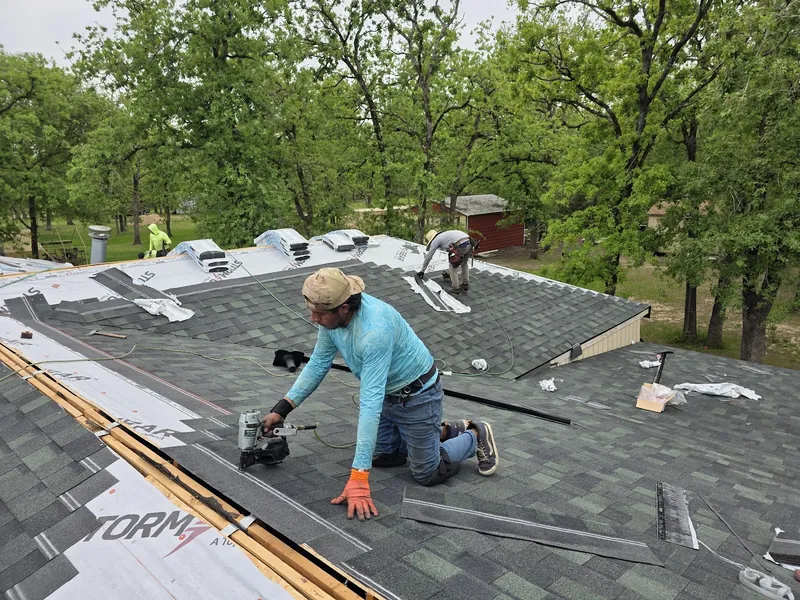
What Hail and Wind Do to a Houston Roof
Storm damage is not one thing. Hail and wind leave different marks, and they show up in different places on the roof. Knowing what each looks like is half of the inspection.
Hail damage on shingles
Hail usually leaves soft spots or dark circles where the stone hit and knocked the protective granules loose. On older shingles the strike can crack the mat underneath. You will often find a lot of granules collecting in the gutters and at the bottom of the downspouts after a hail storm, which is one of the few signs a homeowner can spot from the ground. Hail also dents metal: roof vents, flashing, gutters and the cap on an air conditioning unit can all tell you how big the stones were.
Wind damage on shingles and edges
Wind works from the edges in. It lifts the corners of shingles along the eaves and rakes, creases tabs so they no longer lie flat, and in stronger gusts tears pieces off completely. Ridge caps are exposed on both sides and take a beating. A missing shingle in the yard is the obvious sign. The quieter one is a row of creased tabs that look almost normal until you are standing next to them.
Flashing, vents and the places water gets in
Most leaks after a storm do not start in the middle of a field of shingles. They start where the roof meets something: a wall, a chimney, a pipe boot, a skylight, a valley. A storm can loosen flashing or crack a rubber pipe boot that was already getting brittle. We check every one of those spots, because they are where a small amount of storm damage turns into water in the attic.
Signs of storm damage inside the house
Water stains on ceilings, damp insulation in the attic, light coming through the roof deck, or a musty smell in an upstairs room can all trace back to the roof. If the water has already reached the inside, the roof gets fixed first and then the room. We do drywall and interior work too, so one contractor can put the ceiling back once the leak is stopped.
What a Storm Damage Inspection Looks Like
Call us or send the form and we set a time that works for you. It helps if you can be home so we can walk you through what we found on the spot, but it is not required.
On the roof we work slope by slope. We look at the shingles for hail strikes, granule loss, cracks, lifted and creased tabs and missing pieces, and we check the ridge, the vents, the flashing, the pipe boots and the valleys. We look at the metal on and around the roof for dents, and at the gutters for granules and damage of their own.
Then we show you the damage, or the lack of it, and explain what each thing we found means. If the roof came through the storm fine, we tell you that. If it needs a repair, you get a free estimate for the repair. If the damage is spread across the roof, we explain why a replacement makes more sense than patching. If you are thinking about an insurance claim, we explain how the claim process works so you can decide whether to file. The claim itself is between you and your insurance company. There is more on that on our insurance claim roofing page.
Storm damage often reaches more than the shingles. Gutters take hail and wind at the same time the roof does, and siding on the side of the house facing the storm can be cracked or punctured. We do gutters and siding as well, so if they need work it can be done on the same schedule as the roof.
Why Houston Homeowners Call Roofshire After a Storm
- The inspection is free. You find out what the storm did before you spend anything, and the estimate is free too.
- We show you the damage. You see what we found on your roof instead of being asked to take our word for it.
- Straight answers. If the roof is fine, we say so. If a repair will do, we tell you.
- We stay in touch. Customers mention that we kept them posted at every step until the job was done.
- Clean job sites. The crew cleans up the site when the work is finished, something one customer mentioned in her review.
- Hablamos español. Tell us when you call.
We are rated 5.0 on Google from 36 reviews. Call (832) 995-0575, Monday to Saturday from 10 AM to 6 PM, or send the form any time to set up your free storm damage inspection.