
From This Old House, “Vinyl Siding Cost” (updated June 11, 2026), Bob Vila, “Vinyl Siding Cost” (updated April 18, 2024, citing Angi and HomeAdvisor) and the 2025 Cost vs. Value Report, West South Central region, which includes Texas.
The national vinyl siding install cost runs from about $6,000 to $17,500 for most homes, and This Old House puts the average at $15,315 with materials and labor. For the region that includes Texas, the 2025 Cost vs. Value Report prices a vinyl siding replacement job at $16,542. Where your house lands in that spread depends on how much wall there is, whether the old siding comes off, what is underneath it, and the grade of vinyl you pick.
This guide walks through those numbers, what moves them, and what is different about siding a house in the Houston area. If you would rather have someone look at your walls, our siding replacement and repair page explains how we work, and the estimate is free.
What’s in this guide
- What vinyl siding costs
- What pushes the price up or down
- Siding a house in Houston
- Vinyl vs fiber cement: cost and resale
- Repair or replace?
- What goes into a quote from us
- Vinyl siding cost questions
What Vinyl Siding Costs
Three sources, three slightly different answers. They measure different things: one is a whole-house average, one is a typical range, and one is a defined remodeling job priced the same way in every city.
| What it measures | Cost | Source |
|---|---|---|
| National average, installed | $15,315 | This Old House |
| Typical whole-house range | $6,000–$17,527 (average $11,451) | Bob Vila, citing Angi and HomeAdvisor |
| 2,000 sq ft house, average | $12,252 | This Old House |
| Siding replacement job, West South Central | $16,542 | Cost vs. Value 2025 |
| Labor only | $2.15–$5.25 per sq ft | Bob Vila |
| Insulated vinyl, installed | $8–$10 per sq ft | Bob Vila |
| Removing the old siding | $1–$2 per sq ft | This Old House |
| Vinyl soffit and fascia | $12–$15 per linear foot | Bob Vila |
Figures: This Old House (updated June 11, 2026, from 2025 Homewyse data); Bob Vila (updated April 18, 2024); Cost vs. Value 2025, JLC.
Labor is a big share. This Old House says professional installation adds 30 to 50 percent of the total project price, and its own example has labor at about half the cost of a 2,500-square-foot job. That is why two quotes for the same vinyl can be thousands apart: the difference is usually in what each contractor plans to do to the wall, not in the panels.
What Pushes the Price Up or Down
- Wall area, not floor area. Siding is priced by the square footage of wall to be covered, minus windows and doors. A two-story house with the same footprint has roughly twice the wall of a one-story.
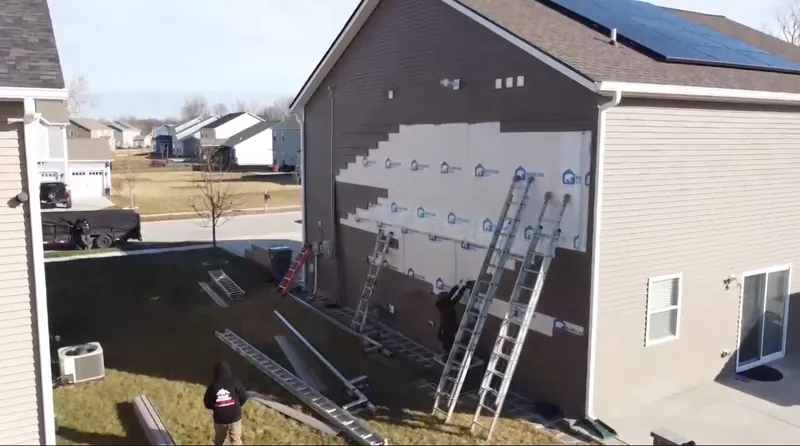
- Tear-off. Taking the old siding off costs extra, but it is also the only way to see what has been happening behind it.
- What is underneath. Rotted sheathing or framing where water sat for years has to be fixed before new siding goes up. That is a cost you only find out about once the wall is open.
- The grade of vinyl. Bob Vila lists thicknesses from builder grade (.040 inch) up to super thick (.050 inch), with the price rising at each step. Thicker panels stand up better to knocks.
- Insulated or hollow. Insulated vinyl has a foam backing. This Old House puts it at $3 to $4 more per square foot in materials than standard siding.
- Trim, soffit and fascia. Corners, window trim and the boxed eaves are measured and priced separately from the flat walls.
- Height and access. Upper-floor walls and tall gables take ladders or scaffolding and more time.
- Gutters. If the gutters have to come down to side the fascia, that is extra time; if they are old, it can be the moment to replace them too.
Siding a House in Houston
Heat
Vinyl expands and contracts with temperature, so it is hung loose enough to move rather than nailed tight. On a west wall in a Houston August, that matters. Panels nailed too tight are the ones that buckle and ripple.
Hail and wind
NOAA’s National Severe Storms Laboratory notes that wind-driven hail can tear up siding on houses. Older vinyl is more brittle and cracks more easily. When a storm hits the roof, the walls on the side the weather came from often take damage too.
If you think a storm did it, start with a free roof inspection: we look at the roof and the walls and show you what we find. If you are weighing an insurance claim, our insurance claim roofing page explains how the process generally works. The claim is between you and your insurance company, and whether to file is your decision.
Sales tax
The Texas Comptroller says labor to repair, remodel or restore residential real property is not taxable. On a lump-sum contract the contractor pays tax on the materials and does not add tax on top; on a separated contract, the materials are listed on their own and carry sales tax. Check which kind each quote is before you compare totals.
Near the coast
Homes in TDI’s designated catastrophe area (14 coastal counties and parts of Harris County east of Highway 146) need a windstorm inspection for most new construction, roof replacements, major repairs and other alterations. TDI’s page does not say whether re-siding counts, so if you are in Galveston or another coastal town, ask before work starts rather than after.
Vinyl vs Fiber Cement: Cost and Resale
Fiber cement is the other siding Houston homeowners usually compare. The Cost vs. Value Report prices both as the same kind of replacement job, which makes it a fair side-by-side.
| Siding replacement | Job cost (region) | Resale value (region) | Cost recouped (region) | Job cost (national) |
|---|---|---|---|---|
| Vinyl | $16,542 | $16,524 | 99.9% | $17,950 |
| Fiber cement | $19,672 | $22,143 | 112.6% | $21,485 |
Region = West South Central (Texas, Oklahoma, Arkansas, Louisiana). Source: Cost vs. Value 2025.
Vinyl costs less up front and, in this region, its job cost comes back almost dollar for dollar in resale value. Fiber cement costs more but recoups more. It is also heavier, takes more care to install, and its painted finish needs looking after. Our siding page compares how the two handle Houston heat, hail and humidity.
Repair or Replace?
Not every wall needs to come off. A few cracked panels on one side of the house, a section knocked loose in a wind storm, or one spot where something hit the wall can often be repaired. The catch with vinyl is matching: siding fades in the sun, so new panels can look different from the weathered ones next to them.
Replacement starts to make more sense when the damage runs across whole walls, when the panels have gone brittle, or when you can see water staining inside that points to a problem behind the siding. Patching now and replacing in two years means paying twice.
What Goes Into a Quote From Us
A siding estimate starts at the house. At the visit we:
- Look at every wall, including the upper floor and the gables, which are the hardest to see from the yard.
- Check the joints where the roof meets the walls, because a stain blamed on the siding often started at the roof edge or the flashing.
- Tell you whether a repair makes sense or whether the damage runs far enough that replacement is the better buy.
- Talk through vinyl, fiber cement and how each looks against your house, including any HOA rules.
- Price the work the house actually needs, with a free estimate.
If the roof is due too, siding and a new roof can go on one schedule with one contractor. Our guide to roof replacement cost in Houston covers that side, and roof inspection cost explains what you get from a free inspection versus a paid one.
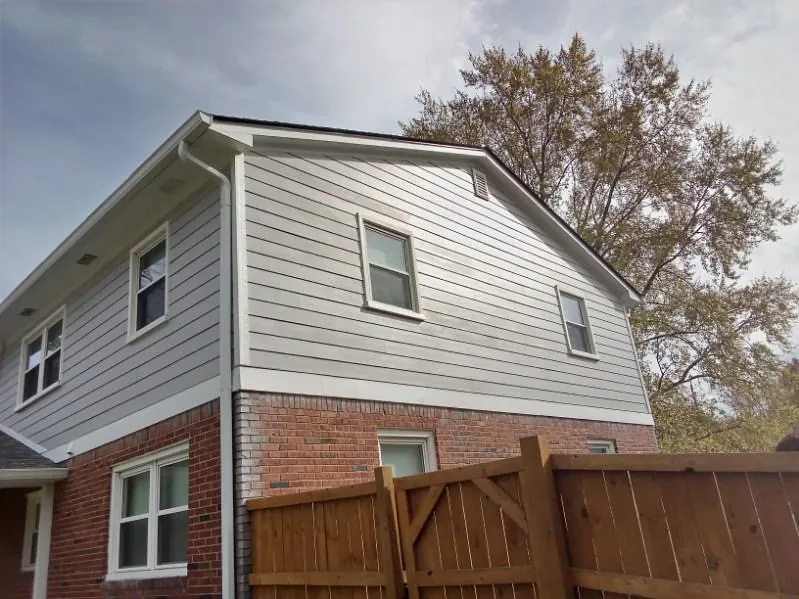
We side homes across greater Houston, from Houston to Spring, The Woodlands, Conroe, Pearland, Missouri City and Fresno. Hablamos español. Get a free siding estimate or use the form on this page.
Sources checked November 17, 2026: This Old House, Vinyl Siding Cost (updated June 11, 2026); Bob Vila, Vinyl Siding Cost (updated April 18, 2024); Cost vs. Value 2025, West South Central; NOAA NSSL, Severe Weather 101: Hail; Texas Comptroller, publication 94-116; TDI, Do I need a windstorm inspection? (updated May 8, 2026).
Vinyl Siding Cost Questions
How much does it cost to install vinyl siding?
This Old House puts the national average at $15,315 installed, and Bob Vila, citing Angi and HomeAdvisor, gives a typical range of $6,000 to $17,527. For the region that includes Texas, the 2025 Cost vs. Value Report prices a vinyl siding replacement job at $16,542. Your price depends on the wall area, tear-off, repairs underneath and the grade of vinyl.
How much is vinyl siding per square foot installed?
Bob Vila lists $2 to $5 per square foot for standard hollow vinyl and $8 to $10 for insulated vinyl, with labor alone at $2.15 to $5.25 per square foot. Removing the old siding adds about $1 to $2 per square foot, according to This Old House.
Is insulated vinyl siding worth the extra cost?
It costs more: This Old House puts insulated vinyl at $3 to $4 more per square foot in materials than standard siding. Whether it pays back depends on the house, so ask for both prices at the estimate and compare.
Does vinyl siding add value to a house?
In the 2025 Cost vs. Value Report for the West South Central region, a vinyl siding replacement recouped 99.9 percent of its cost in resale value, and fiber cement recouped 112.6 percent. Those are averages for a defined job, not a promise for any one house.
Is labor for siding taxed in Texas?
The Texas Comptroller says labor to repair, remodel or restore residential real property is not taxable. Materials are taxed: on a lump-sum contract the contractor pays that tax when buying them, and on a separated contract the materials carry sales tax on your bill.
Can hail damage vinyl siding?
Yes. NOAA's National Severe Storms Laboratory notes that wind-driven hail can tear up siding, and older vinyl cracks more easily. If a storm hit your roof, check the walls on the side the weather came from. Roofshire's roof inspection is free, and we look at the walls while we are there.